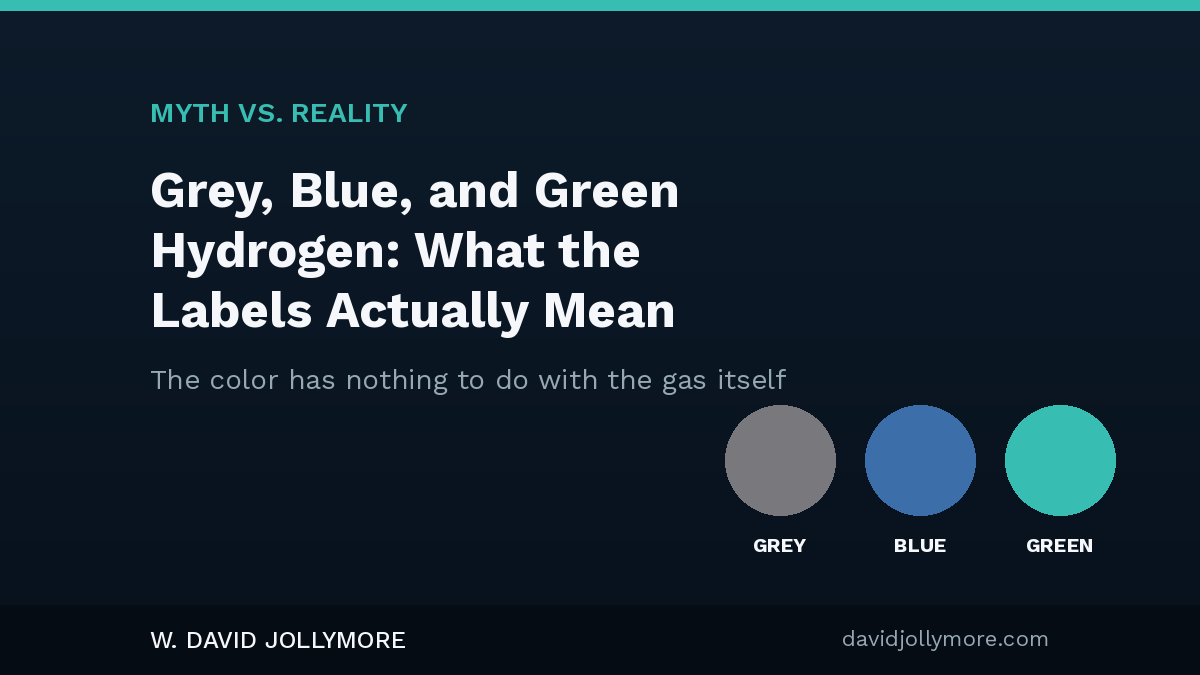
Grey, Blue, and Green Hydrogen: What the Labels Actually Mean
Grey, Blue, and Green Hydrogen: Why the Label Matters More Than the Marketing
Understanding grey, blue, green hydrogen is the fastest way to see past industry marketing to what’s actually being produced.Hydrogen is colorless. The “colors” you hear in every industry conversation — grey, blue, green — have nothing to do with the gas itself. They’re shorthand for how it was produced, and that distinction determines almost everything that matters: cost, emissions, and how close a project actually is to “clean.”
Grey Hydrogen
Produced via steam methane reforming (SMR) from natural gas, with no carbon capture. It’s the cheapest and most common form of hydrogen today — over 95% of global supply — and also the highest-emitting, generating roughly 10–19 tons of CO2 per ton of hydrogen produced.
Blue Hydrogen
The same SMR process as grey hydrogen, but paired with carbon capture and storage (CCS) to reduce emissions. Blue hydrogen cuts carbon intensity significantly compared to grey — but it isn’t zero-emission, and it still depends on natural gas infrastructure and CCS build-out.
Green Hydrogen
Produced by electrolysis — splitting water into hydrogen and oxygen using electricity from renewable sources like wind or solar. It’s the cleanest pathway available, with minimal emissions, but it currently makes up less than 0.1% of global hydrogen production, largely due to cost and renewable electricity availability.
Why the Label Matters More Than the Marketing
When you see “hydrogen economy” or “clean hydrogen” in a headline, the color behind that project is the single most important fact the headline usually leaves out. A grey hydrogen project marketed with green-hydrogen language isn’t a technical error — it’s the difference between a real climate solution and business as usual with better branding.